



 by Simin Xiang
Quick Answer:
Lamination coats polypropylene woven fabric using plastics or films to enhance its moisture resistance, surface properties, and printability. Proper lamination will depend on packed goods, barrier requirements, printing technique, and desired fabric weight. As for users asking about laminated polypropylene woven fabric, what really matters are factors such as coating technique, film selection, coating weight, GSM, and one-sided or double-sided application. XIFA Group produces PP woven bags with coating and lamination possibilities, with production capabilities involving five composite bag production lines.
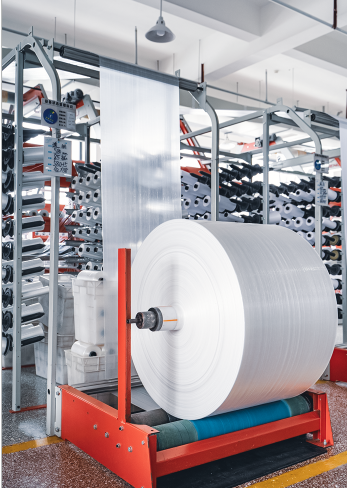
The PP woven fabric has polypropylene tapes woven in the warp and weft directions, while lamination consists of additional layering. Additional layering helps to decrease openings between the woven tapes and makes the surface continuous, increasing moisture protection and graphic quality.
The PP laminated woven fabric may have an additional extrusion layer of polymer or film laminated onto the PP woven fabric. XIFA also produces such products as BOPP laminated films. Graphic images may be printed on the film before laminating it to the woven fabric.
This guide covers the topic of additional surface structure of the product.
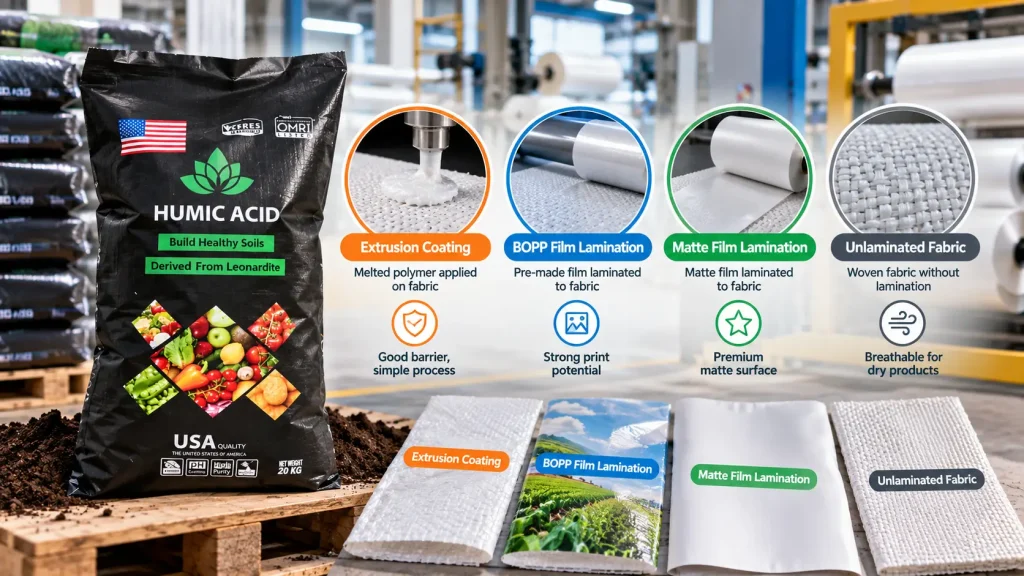
Extrusion coating involves the application of melted polymer on the substrate. In film lamination, the woven fabric is laminated with a film that is produced independently.
According to XIFA, adhesive lamination involves bonding two substrates using an adhesive.
| Structure | Barrier | Print potential | Relative process complexity | Common use |
| Extrusion coating | Good | Basic to moderate | Lower | Industrial sacks, liners |
| BOPP film lamination | Good | Strong graphic capability | Higher | Feed, rice, fertilizer |
| Matte film lamination | Good | Premium matte surface | Higher | Branded packaging |
| Unlaminated fabric | Limited | Basic | Lowest | Breathable dry products |
Price is influenced by film type, coating weight, printing method, quantity, and construction. The table, hence, should help in determining the requirements and not be used for determining prices.
The PP woven substrate carries out the primary structural role while the lamination provides the surface characteristics.
The application of a continuous coating helps minimize water and moisture transfer across the fabric surface. XIFA claims its coated woven packaging to be waterproof and leak-proof. But the performance of waterproof PP woven fabric depends on various factors such as seams, needle punctures, closures, and others. Waterproofing does not necessarily mean making the whole packaging completely watertight.
Lamination gives more surface smoothness compared to the woven tapes. It is particularly important when it comes to branding and labeling. BOPP packaging goes even further with printing. The graphics can be applied in reverse to the film during printing prior to lamination.
In the present-day catalog of products, XIFA provides examples of gravure-printed BOPP laminations with single-side and double-side lamination.
The laminated vs unlaminated PP fabric decision depends on whether the application needs barrier protection or a more printable surface.
| Factor | Laminated | Unlaminated |
| Moisture barrier | Higher | Lower |
| Surface | Smoother | Woven texture |
| Detailed graphics | Better suited | More limited |
| Breathability | Lower | Higher |
| Added material | Yes | No added laminate |
| Typical use | Moisture-sensitive or printed goods | Dry goods needing airflow |
Unlaminated fabric could still be ideal in applications where airflow would help. Lamination comes into play where moisture, leakage, or graphics are involved. It is for this reason that coated PP woven fabric cannot replace uncoated fabric in every application.
The packed product is what will determine the right lamination structure.
BOPP-laminated packaging is commonly used in situations where the product needs to be branded as well as protected from moisture. According to XIFA, applications include animal feed, fertilizer, seeds, and food packaging. An example of such a product would be rice packages.
Industrial powders and pellets might require a coated PP woven fabric to minimize moisture infiltration and product leakage. Common applications include cement, fertilizer, chemicals, and resins. The closure design is still significant due to the potential for fine product leakage from the seam.
A waterproof PP woven fabric can be used to protect moisture-sensitive products during storage and transport in damp conditions. Additional liners might be needed in cases where more moisture protection is necessary. The barrier should thus be treated as an entire packaging system rather than just a coating material.
GSM represents the gram weight per square meter of fabric. Denier specification represents the linear density of the tape or yarn used in weaving. None of these parameters should be selected alone. The width of the tape, weave density, resin, coating, and bag construction are relevant.
The buyer must specify whether the desired GSM refers to the base woven fabric or the final laminate. This is to avoid any confusion owing to additional material added through the lamination process. Published product range by XIFA includes base woven fabric made from PP woven fabric in 60, 70, 80, 90, and 110 GSM.
The requirement for an RFQ on PP-coated woven fabric must include the type of coating or film, along with whether treatment is needed for either or both sides. The different types, such as BOPP, matte film, and others, must be mentioned distinctly. The required coating or film weight must also be specified if applicable.
The RFQ will start by mentioning the packed items along with the purpose that they will serve. This will help determine the requirement for lamination.
Fabric GSM, desired GSM, size, color, coating type, lamination sides, printing method, color requirement, size of the rolls, and the order quantity have to be stated clearly.
In case of technical usage, the requirements for tensile strength, tear resistance, moisture content, and adhesion of the coating should be mentioned with the test method, since the acceptance will be based on the test result.
The manufacturing capability of XIFA includes making PP fabric, printing, composite making, cutting, and sewing. It consists of raw materials to finished goods quality control.
Request a sample roll and specification review of coating, film, GSM, and printing structure from XIFA.
Not necessarily. While lamination provides improved waterproofing, there are still areas such as stitching, zippers, and perforations that are potential sources of water ingress.
No. Extrusion coating involves melting and applying a polymer onto a substrate. BOPP lamination involves attaching an oriented film to the woven substrate.
No. The laminated vs unlaminated PP fabric choice depends on barrier, printing, breathability, and cost requirements.
Yes. Both single-side and double-side BOPP Film Lamination is available in the published specifications by XIFA.
Provide application, fabric GSM, sizes, coating/film type, which side to laminate, print options, roll size, and order volume.