



 by Simin Xiang
When packaging looks sharp, consistent, and still visually intact after long transport and handling, there is a strong chance it was produced using rotogravure printing. This method is widely used in flexible packaging because it delivers stable color reproduction, high precision, and reliable performance across large production runs.
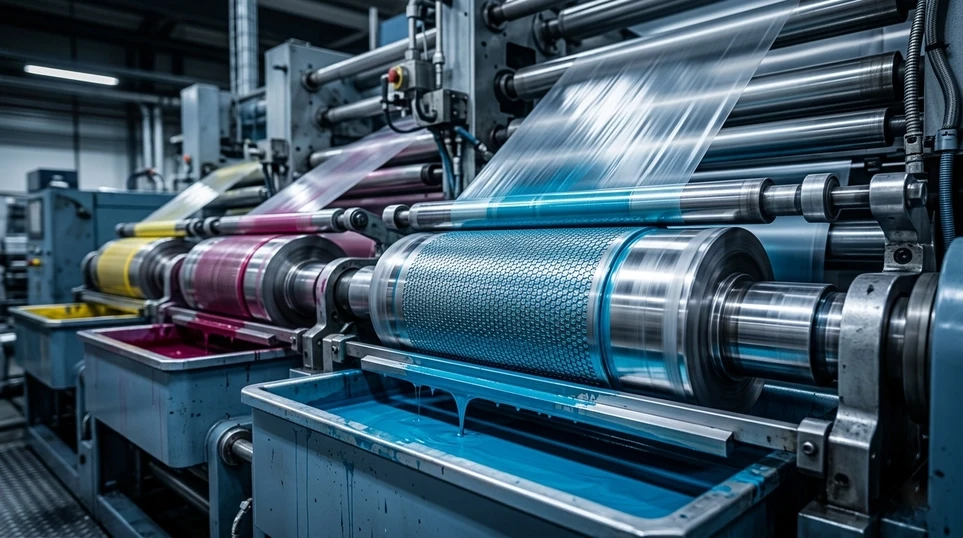
To understand rotogravure printing, it helps to start with its structure and basic function. Rotogravure is an intaglio printing process where the image is engraved directly into a metal cylinder. Instead of applying ink on a flat surface, the ink is stored inside tiny recessed cells carved into the cylinder.
This allows controlled ink transfer onto flexible materials with high consistency and precision. Because of this system, the process produces stable and repeatable results ideal for consistent branding and detailed designs.
The process begins with color separation, where each color in a design is assigned to its own cylinder. These cylinders typically have a steel core for strength, a copper layer for engraving, and a chrome coating for durability. During printing, each cylinder rotates through an ink bath, filling the engraved cells with ink.
A doctor blade removes excess ink from the surface, leaving ink only inside the recessed cells. As the cylinder presses against the film, ink transfers evenly, producing clean and consistent images even at high speeds.
Cylinder engraving is the technical core of this printing method and directly affects print quality. Each engraved cylinder contains thousands of microscopic cells that determine how much ink is transferred.
Deeper cells carry more ink for darker areas, while shallower cells handle lighter tones and fine details. This structure allows precise control over image reproduction, even for complex artwork. As a result, text stays sharp, barcodes remain readable, and visual elements remain consistent across large volumes.
Modern rotogravure systems often use 8-color high-speed machines to enhance color richness and depth. Each color is applied in sequence, allowing layered designs with smooth transitions and strong contrast.
Automated registration systems ensure precise alignment between colors throughout the printing process. This is critical because even small misalignments can affect the final appearance of the packaging. With these systems, packaging maintains consistent branding and visual quality whether produced in small or large batches.
BOPP, or biaxially oriented polypropylene, is commonly used in flexible packaging due to its strength, clarity, and smooth surface. It is typically treated to improve ink adhesion, allowing printed designs to bond securely.
Rotogravure works well with BOPP because it delivers stable ink transfer while maintaining high-speed efficiency. The smooth surface enhances image clarity, while the material’s durability supports long-term performance. When laminated with stronger substrates, the printed layer becomes part of a structure that resists moisture, abrasion, and handling stress.
In production, designs are printed in reverse onto clear BOPP film using multiple color cylinders. Each layer is applied step by step until the full design is complete. After printing, the film is laminated onto a stronger base material to combine visual quality with structural strength. This layered construction protects the print from scratches, fading, and environmental exposure. As a result, the packaging maintains its appearance even under demanding storage and transport conditions.
Unlike simpler printing techniques, rotogravure printing is designed for scale and consistency. It is especially valuable for BOPP-based packaging where both durability and visual quality must remain stable throughout storage, shipping, and retail handling. For procurement teams and technical buyers, understanding how this process works helps in selecting packaging that performs reliably in real-world conditions.
Large-scale rotogravure printing depends heavily on process control. Facilities like XIFA Group use automated registration systems, continuous inspection points, and ISO-certified quality management processes to ensure consistent output.
With a 72,000㎡ production facility and multiple 8-color printing lines, consistency is maintained across large production volumes. These systems help reduce defects such as color variation, misalignment, and printing inconsistencies.
Sedex SMETA audits further support ethical and operational standards, ensuring controlled and repeatable production quality for global supply chains.
It is a printing method where images are engraved into cylinders that transfer ink directly onto a material with high precision and consistency.
Each engraved cell holds a fixed and controlled amount of ink, ensuring uniform reproduction across long production runs.
Because it delivers sharp images, stable colors, and durability, it is suitable for packaging that undergoes handling and transport.