



 by Simin Xiang
Quick Answer:
Generally speaking, the HS code for PP woven fabric is 5407.20 when the PP strip qualifies as such for weaving the fabric. Finished bags would usually have HS 6305.33. Other considerations, like coating or laminating, strip width, and destination country, could have some impact as well. Given all of that, the PP woven fabric HS code should always be determined based on the product specification itself. A description of the product supplied by the exporter would not suffice for classification purposes. PP woven fabric and bags are produced by XIFA Group in China. Product specifications are available upon request.
It affects the procedure of declaration in relation to customs duties and taxation as well as other trade restrictions. Incorrect classification can cause delays, higher tariffs, or an additional documentation request.
In accordance with the Harmonized System, there are six-digit codes for headings and subheadings. Countries are free to add more digits for classification of the commodity in their own tariff.
This implies that a polypropylene woven fabric HS code in one country will have additional digits in another. It is important for the importer to differentiate between international HS classification and the full tariff code at the destination.
There is also importance of product form. Fabric rolls and sacks are classified as different products.
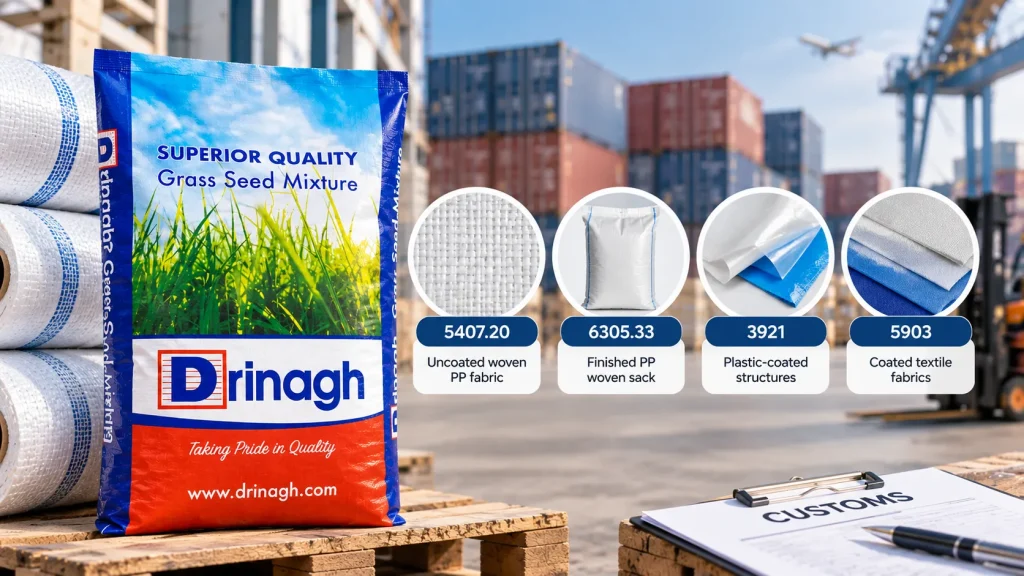
Below are some sample HS codes that serve as an ideal starting point. However, they cannot be used as standard codes.
| Product form | Common HS heading | General description |
| Uncoated woven PP fabric | 5407.20 | Woven fabric of synthetic strip or similar material |
| Finished PP woven sack | 6305.33 | Sacks and bags made from polyethylene or polypropylene strip |
| Certain plastic-coated structures | 3921 | Plastic sheets, film, foil, or strip |
| Certain coated textile fabrics | 5903 | Textile fabrics coated, covered, or laminated with plastics |
The HS code for PP woven fabric will be determined by the way in which the polypropylene strips or the finished fabric meets the legal definition of the heading and chapter notes. More information is required from importers besides the product name.
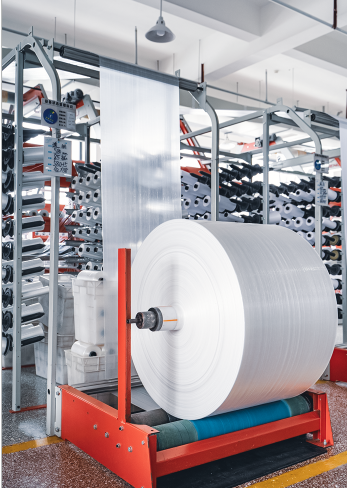
PP woven fabric roll is still an intermediate product that may be further treated to be cut, printed, laminated, and sewn into the packaging. In contrast, the finished sack already possesses all the necessary qualities of the packaging. Therefore, the typical HS code of the PP woven bags is 6305.33, but not the fabric codes.
Classification usually considers the appearance of the goods. However, the importation of the fabric that will be used for further processing into the sacks does not automatically mean the classification of the imported fabric as the finished good. The significance of this matter can be observed while making a comparison of the quotations of the suppliers.
The lamination of the PP fabric should be looked at in more detail because the plastic coating may affect the appropriate chapter to be used in classification.
The US customs rulings indicate that certain construction may play a role. The particular textile fabrics which have visible coatings of plastic on both sides belong to Chapter 39, but not to any textile chapter.
Other laminated or coated textile fabrics may be placed in Chapter 59.
As a result, PP woven fabric customs classification should identify:
The classification of the “laminated PP fabric” is not possible based on the given description.
The first six HS digits provide an international framework, but national tariff schedules extend those codes.
For example, a country may use eight or ten digits to identify a more specific product. Duty rates can also differ by origin and trade agreement.
Therefore, the HS code for PP woven fabric should be checked in the importing country’s current tariff database. The destination customs authority has the final say on classification.
Importers should also check whether anti-dumping, safeguard, or other trade measures apply. These measures can depend on product construction, origin, and destination.
The technical details must be sufficient for the customs officials to know what is coming into the country. The commercial invoice must contain an accurate description rather than just the trade name. Packing lists must agree with the volume, weight, and packaging.
In case of PP woven fabric, the specification will include polypropylene composition, strip width, weave, GSM, measurements, coating, and lamination. In case of bags, there will be bag measurements, closing, printing, liner, and construction.
Documentation of the country of origin, along with the certificate, where required, must also be prepared. The buyers must check their documentation requirements with the customs broker of the destination country prior to shipment.
XIFA provides custom-made PP woven fabrics along with batch traceability. The quality control system also captures inspection data for incoming materials up to product delivery.
A practical classification review starts with the physical product rather than a previously used code.
First, determine whether the shipment contains fabric rolls, tubing, cut material, or finished bags. Next, confirm material composition, strip width, GSM, and construction.
For laminated products, record the coating material and how it is applied. These details help distinguish possible textile and plastics headings.
The polypropylene woven fabric HS code should then be checked against the destination country’s tariff schedule. For uncertain or high-value shipments, a customs broker or binding classification ruling may provide greater certainty.
This process is especially useful when changing suppliers. Two products sold under the same commercial name may not have identical construction.
No. It is commonly considered for woven fabrics of synthetic strip, but construction and destination-country rules must still be reviewed.
HS 6305.33 commonly covers sacks and bags made from polyethylene or polypropylene strip or similar material. Specific national digits may follow.
It can. The coating material, number of coated sides, visibility, and overall construction may affect classification.
The international HS system is harmonized at six digits. Countries can create additional tariff subdivisions beyond those six digits.
A manufacturer can provide technical specifications and commonly used codes. Final PP woven fabric customs classification remains subject to the importing country’s customs rules.