



 by Simin Xiang
Quick Answer:
LDPE tends to be softer and more flexible compared to HDPE, which is harder and can be stronger even if thinner. Your optimal choice depends on the form of loading, vulnerability to puncturing, sealability, look, and necessary thickness. For those choosing between LDPE vs HDPE bags, the thickness should not be your only concern. Resin quality, film composition, design of a bag, and process parameters play their role as well. XIFA Group produces PE film bags intended for industrial packaging. It has the capacity for film blowing and custom packaging solutions.
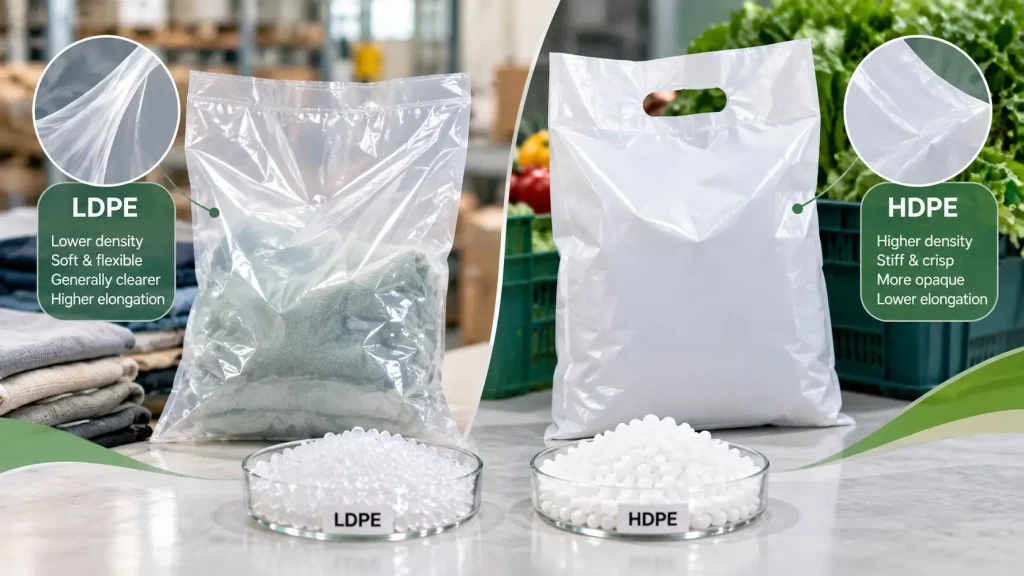
LDPE and HDPE are both forms of polyethylene, but they have different molecular structures. This makes a difference in density, rigidity, flexibility, and film-forming ability. The following table gives the general characteristics of LDPE and HDPE in relation to purchasing bags.
| Property | LDPE | HDPE |
| Density | Lower | Higher |
| Feel | Soft and flexible | Stiff and crisp |
| Clarity | Generally clearer | Usually more opaque |
| Elongation | Higher | Lower |
| Stiffness | Lower | Higher |
| Heat sealing | Broad sealing suitability | Requires different sealing conditions |
| Typical bags | Liners, parts bags, flexible packaging | Grocery, produce, thin-gauge bags |
These are general features. Performance of actual HDPE and LDPE film depends on the resin grade, thickness, composition, and manufacturing process.
A polyethylene bag made from low-density polyethylene (LDPE) will elongate prior to failure, making it ideal for use with bagged products whose shapes vary. Flexibility makes LDPE plastic bags excellent for use as liners, industrial components, and products under irregular strain on the film.
High-density polyethylene (HDPE) is more rigid and has stronger intermolecular attraction since it has fewer branched polymers. Consequently, polyethylene bags made from HDPE can exhibit good tensile performance even with thin film.
In puncture resistance, film thickness becomes relevant, although choice of resin becomes important as well. A thin film does not necessarily suit use with sharp or abrasive product packaging.
Buyers should try out the final product with actual packing to check puncture resistance. Stress points like corners, edges, granules, and handling can become issues that laboratory film thickness measurement does not catch.
Both of these materials are resistant to moisture and a range of chemicals, and this is why they are widely used as liners and protective bags.
It is important to note that chemical resistance is not an absolute feature since factors such as temperature, time of contact, concentration of the chemical, and stress caused by the film might influence the resistance.
Concerning chemical packaging, it should be stated that the appropriateness of the material for that chemical should be determined.
A comparison of HDPE with LDPE films would be inaccurate in assuming that the same thickness equals the same performance.
The stiffness of HDPE allows for use of thinner gauges, whereas more material would be used in LDPE if the same stiffness were needed, but it would provide added softness and flexibility.
The calculation of cost must therefore take into account the total requirement of the bag, and not simply the cost of resins used.
Reducing the thickness of the film reduces the amount of material used. But reducing beyond a certain extent may cause more number of punctures, split seals, or loss of product. Testing a sample is always preferred over selecting films with minimum quoted thickness.
The smooth and flexible nature of LDPE bags allows surface treatments, if required, for good printing. HDPE film is also printable but with different properties and stiffness than those of LDPE films.
LDPE is popular in applications where heat sealing and flexibility are significant. Heat sealing is possible with HDPE, but with different temperature and machinery requirements.
In the case of pre-made bags, seal performance requires as much consideration as film thickness. A strong film may fail due to poor bottom and side seals that could not withstand packed weight.
LDPE finds application where heat sealing and flexible seals are needed. While heat sealing can be done with HDPE film too, the temperature requirement differs.
When pre-forming bags, it is important to pay attention to seal shape rather than the thickness of the film. Even if the film is flexible, it will not work unless it is capable of holding the load in the bag.
A practical LDPE vs HDPE bags decision can start with the following matrix.
| Requirement | LDPE | HDPE |
| Soft feel | Better fit | Less suitable |
| High flexibility | Better fit | Moderate |
| Stiff film | Less suitable | Better fit |
| Thin-gauge bag | Application dependent | Often suitable |
| Irregular contents | Often suitable | Requires testing |
| Clear appearance | Generally better | Generally lower clarity |
| Industrial liner | Common choice | Application dependent |
| Heat sealing | Commonly suitable | Settings need adjustment |
The final specification should include resin type, film thickness, dimensions, sealing method, printing, load weight, and performance requirements.
XIFA states a 10,000-piece MOQ for its PE film bag category. Buyers can request custom specifications based on the packed product and intended use.
Request a PE film sample and specification from XIFA to compare the appropriate film structure before bulk production. Contact us to get started.
Well, this depends on how one measures strength. While HDPE is known for its high stiffness, LDPE allows more flexibility and elongation.
LDPE film usually gives more clarity. Film of HDPE is often more translucent or even opaque.
Yes, provided that film thickness, bag size, quality of seals, and resin blend correspond to the weight.
Sometimes HDPE allows achieving necessary stiffness and strength with the help of smaller thickness. This needs to be confirmed by finished bag testing.
This is best done using their product and conditions of handling. Buyers need to consider puncture resistance, elongation, sealability, size, printing, and performance of filled bags.