



 by Simin Xiang
Quick Answer:
Poly bag thickness can be measured in either microns or mils, however, thickness is not everything that affects poly bag performance. Other factors that affect poly bag performance include resin used, film compound, bag size, seals, load profile and test results. Poly bag thickness guide focuses on how to compare the various measurements and how to create specification for off-the-shelf PE bags. One mil is equal to 25.4 microns, meaning that a 2 mil film will have a thickness of 50.8 microns. XIFA Group produces industrial PE packaging. Properties of PE bags from XIFA include resistance to moisture, chemical, low temperature, and oil.
Both represent units used to specify the thickness of the film. Microns are popularly used in metric units while mil is popular in North America for packaging.
Difference between mil and micron:
µm represents a micron unit that means 0.001 millimeter while mil unit means 0.001 inch. Some of the conversions of micron unit and mil unit are:
Microns = mil * 25.4
Mil = microns/25.4
In other words, a 100 micron thick film is equivalent to 3.94 mil.
The chart below displays some nominal conversion factors that can be used in industrial packaging.
| Mil | Microns | Millimeters |
| 1 | 25.4 | 0.0254 |
| 2 | 50.8 | 0.0508 |
| 3 | 76.2 | 0.0762 |
| 4 | 101.6 | 0.1016 |
| 5 | 127.0 | 0.1270 |
| 6 | 152.4 | 0.1524 |
| 8 | 203.2 | 0.2032 |
Note: This is mathematical conversion. The actual bag thickness of PE bags should be determined depending on the product, loading, handling conditions, and composition of the film.
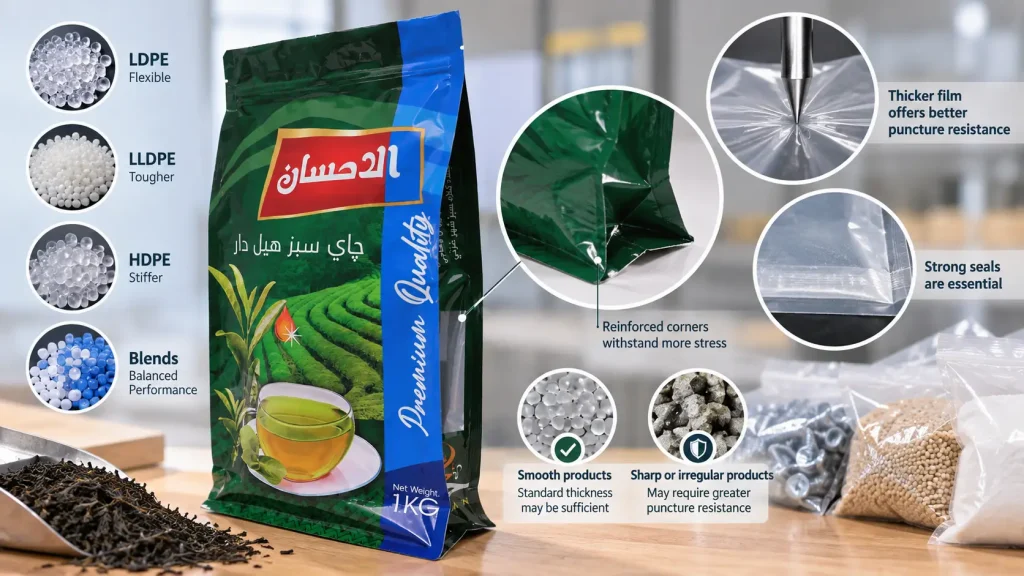
Thicker polyethylene bags typically have more material to resist punctures and tears. However, doubling the thickness doesn’t necessarily double the strength of the bag.
LDPE, LLDPE, HDPE, and their combinations behave differently at the same thickness level. It is the type of resin, formulation, extent of orientation, and other processing variables that determine the flexibility of the bag. The quality of seals is no less crucial. Thick film with poor sealing at the bottom or sides will simply wear out during filling anyway.
The corners concentrate stress. Therefore, the machinery parts, grains, or other non-smooth products may require greater puncture resistance than smooth products of the same weight.
There is no one-size-fits-all thickness table since there will be variations in film performance depending on the type used. These are typical ranges that serve as a basis for discussion in RFQs.
| Application | Typical starting range | Main concern |
| Light liners and protection | 1–2 mil | Dust and moisture |
| General industrial parts | 2–4 mil | Handling and abrasion |
| Heavier components | 4–6 mil | Tear and puncture |
| Sharp or demanding loads | 6–8+ mil | Puncture and load stress |
The thickness of a heavy-duty polyethylene bag must be verified using tests and samples. The size of the bag and geometry of the products may affect its performance significantly. XIFA offers its listing of PE bags used in industrial parts and fertilizer applications. It also shows a sample of a 25 kg pack using 17-micron film.
It can be erroneous to compare films in terms of microns alone because polyethylene types have varying mechanical characteristics.
LDPE is flexible and has an excellent elongation capability. These features could allow for the film to stretch over oddly shaped items without tearing instantly. The softness of the material is another feature that makes it ideal for certain applications.
HDPE is generally stiff compared to LDPE. It gives excellent strength at lower gauges of the film. Its tear characteristics and feel differ from those of the LDPE films. Blends will give different characteristics. Because of this, there is a need to specify heavy-duty polyethylene bag thickness in conjunction with resin.
Without a tolerance stated for a nominal gauge, there is room for doubt on what allowable manufacturing variations there are.
The RFQ should mention the nominal thickness of PE bags along with the means of measuring it. There is also the option for buyers to set tolerances or minimum thickness values if needed.
There must be agreement on where the measurement of thickness will take place since blow film may not always be perfectly even. It is also important to clarify if thickness relates only to one side of the film.
Film thickness may be measured by suitable film gauges or micrometers. However, it is advisable to include a gauge test with other tests which take into account practical application of the bag.
Depending on the application, customers may demand testing for tensile, elongation, tear, puncture, seal strength, leakage, or drop tests. Tests of bags loaded with material will also highlight possible issues not evident from film measurements.
The sampling should be comprehensive and cover various bags and production sites, not one single measurement.
According to XIFA, their production process involves quality control and QR coding of batches. For custom made PE bags, the specified requirement should define what qualities need to be tested.
Some of the aspects that should be considered in an RFQ are the bag size, film type, thickness, tolerance, weight of the product to be packed, expected handling conditions, type of closure/seal, and performance test requirement.
Practical RFQ checklist
| Specification | Information to provide |
| Bag size | Width × length, plus gusset if needed |
| Resin | LDPE, HDPE, blend, or required performance |
| Thickness | Mil or micron |
| Tolerance | Agreed gauge range |
| Product | Powder, parts, granules, or other goods |
| Load | Net packed weight |
| Performance | Tear, puncture, seal, or drop requirements |
| Features | Printing, zipper, flat bottom, or other design |
| Quantity | Trial and production volume |
Not always. Thickness means having more material, however, other factors like resin composition, sealing process, film quality, and product shape affect its performance.
Both would work as long as there is no ambiguity. The conversion between “mil” and “micron” must not be left to interpretation given that quotes will come from different parts of the world.
Yes, especially in cases where the product is heavy, sharp, or irregular.
No guide for the best poly bag thickness can choose the film solely based on the gauge. It is necessary to consider the thickness of the film alongside other factors such as resin, formulation, seals, load, dimensions, and handling conditions.
In terms of ready-made bags, the thickness of the polyethylene film has to be included in the RFQ along with performance specifications.
Request a film sample and custom PE bag specification from XIFA Group before confirming production thickness. Contact us immediately.