



 por Simin Xiang
De acordo com a norma ISO 21898:2024, a etiqueta de um FIBC deve indicar a identidade do fabricante, a carga de trabalho segura, o fator de segurança e a data de fabricação. A ausência de qualquer uma dessas informações pode resultar na rejeição da sua remessa no porto.
Este guia explica os itens de etiquetagem obrigatória, a classificação do código HS e as marcações de transporte da ONU. Você aprenderá a ler cada campo, decodificar uma sequência da ONU e aplicar práticas que mantêm a movimentação de cargas.
A norma ISO 21898:2024 exige que todos os big bags possuam um rótulo durável que permaneça legível após o enchimento. Essa norma existe para proteger tanto os operadores quanto a carga durante o manuseio e o transporte.
Cada etiqueta FIBC em conformidade deve incluir os seguintes campos:
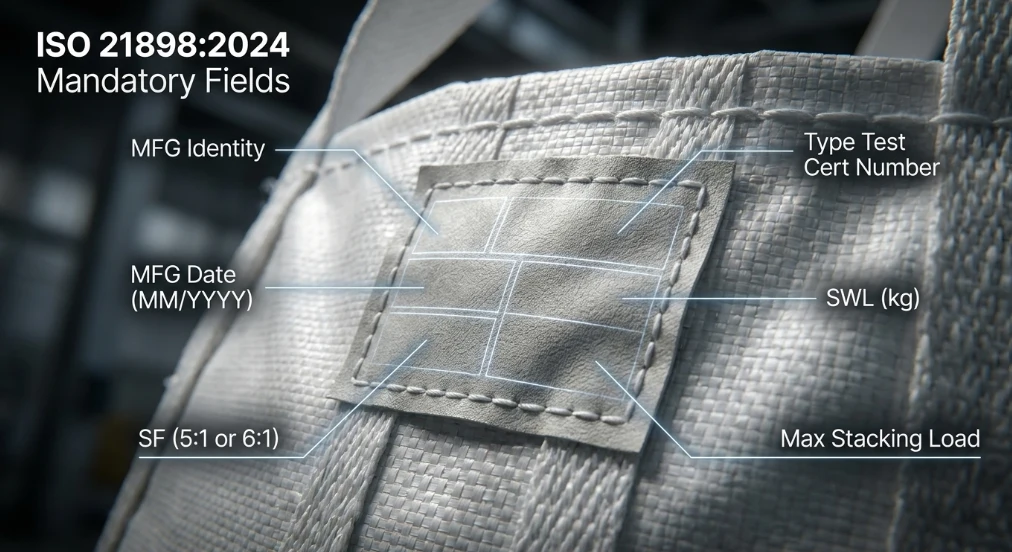
Segue um modelo de texto simples que você pode usar como referência:
FABRICANTE: [Nome / Símbolo / Endereço]
CERTIFICADO DE TESTE DE TIPO: [Número]
DATA DE FABRICAÇÃO: [MM/AAAA]
SWL: [kg] SF: [5:1 ou 6:1]
CARGA MÁXIMA DA PILHA: [kg]
PRODUTO: [Material, se certificado]
INSTRUÇÕES: [Encher / Esvaziar / Aterrar, se necessário]
Esses dois números são cruciais, mas os operadores frequentemente os interpretam incorretamente. Acertá-los protege sua carga e seu histórico de conformidade.
SWL é a carga máxima que a bolsa suporta em uso normal. É um limite máximo, não uma meta. SF indica a margem de ruptura testada. Uma bolsa 5:1 com capacidade nominal de 1.000 kg foi testada até 5.000 kg antes de romper.
Um fator de segurança de 5:1 indica um único ciclo de enchimento e esvaziamento. Um fator de 6:1 significa que a bolsa passou no teste cíclico de elevação superior e é adequada para múltiplas viagens. Escolher o fator errado invalida a reutilização segura. Nosso guia sobre tipos de sacos FIBC Analisa detalhadamente cada opção de construção.
Os rótulos padrão e as marcações da ONU são distintos. A marcação da ONU só aparece em sacos certificados para o transporte de mercadorias perigosas por meio de testes acreditados.
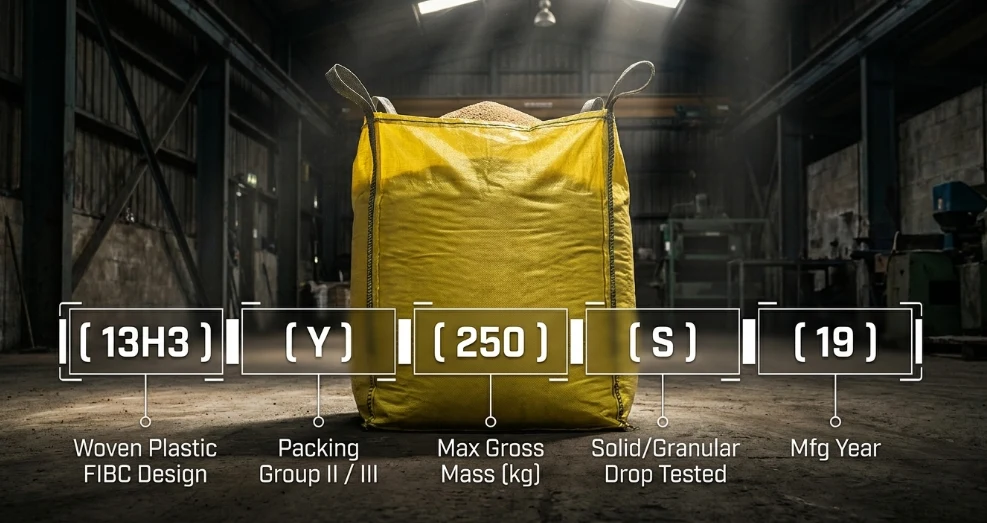
Considere a sequência de exemplo 13H3/Y/250/S/19/D/ABC123:
| Código | Significado |
| 13 | contêiner flexível intermediário para granel |
| H | Tecido plástico trançado |
| 3 | Código do tipo de design |
| Y | Grupo de embalagem II e III |
| 250 | Massa bruta máxima (kg) |
| S | Teste de gota sólida/granular aprovado |
| 19 | Ano de fabricação |
| D | País de autorização |
| ABC123 | Identificador do fabricante |
Para sacos que transportam resíduos regulamentados, consulte nosso artigo sobre Armazenamento de resíduos perigosos em big bags FIBC Oferece conselhos práticos de manuseio.
Os sacos utilizados perto de vapores inflamáveis ou poeira combustível possuem uma marcação do tipo A, B, C ou D, de acordo com a norma IEC 61340-4-4.
Exemplo de caso: Uma empresa de processamento químico que lida com pó sensível à eletricidade estática mudou do Tipo A para o Tipo D. Isso eliminou as verificações de aterramento e reduziu o risco de ignição durante a transferência.
Os funcionários da alfândega usam códigos de classificação para processar cargas. O código HS para sacos FIBC geralmente se enquadra em 6305.32 para contêineres flexíveis intermediários a granel contendo materiais têxteis sintéticos.
Declarar o código HS correto da FIBC agiliza o desembaraço aduaneiro e reduz disputas alfandegárias. Atender aos requisitos de embalagem para exportação da FIBC também significa que as etiquetas devem corresponder aos documentos de embarque.
Exemplo: Uma remessa ficou retida no porto porque o número do lote e a data de fabricação estavam ilegíveis. O importador não conseguiu verificar a certificação e o contêiner ficou parado por dias antes de ser liberado.
Boas práticas de etiquetagem de big bags (FIBC) evitam esse problema. Impressão durável, posicionamento correto e números de lote legíveis mantêm a movimentação de mercadorias. Equipamentos de manuseio adequados, como o cintas de estiva em sacos FIBCAlém disso, protege a integridade da etiqueta durante o levantamento.
O Grupo XIFA é um fabricante de embalagens que produz tecido PP, sacos BOPP, big bags FIBC e sacos de filme PE. Com cerca de 25 anos de experiência, opera uma fábrica de 72.000 metros quadrados e conta com mais de 800 funcionários.
A empresa aplica os sistemas de gestão ISO 9001, ISO 14001 e OHSAS 18001. Oferece suporte às normas BRCGS, FDA, ISO 22000, embalagens para alimentos e para produtos perigosos, conforme aplicável. Rastreamento por código QR, testes de queda e retenção de amostras fornecem aos gestores de logística registros verificáveis.
Seguir as melhores práticas de etiquetagem de big bags (FIBC) com rastreabilidade por leitura de código de barras ajuda a reduzir o risco de retenção portuária durante a exportação.
A rotulagem clara mantém os envios de FIBC em conformidade e em movimento. Verifique a Carga Máxima de Trabalho (SWL), o Fator de Segurança (SF), a carga de empilhamento e a data de fabricação antes do envio de qualquer embalagem. Para mercadorias perigosas, confirme se a marcação da ONU e o tipo de material antiestático correspondem ao seu material.
Grupo XIFA Combina um rigoroso controle de qualidade com experiência em exportação global para atender a essas necessidades. Explore o coleção completa e encontre embalagens desenvolvidas para conformidade transfronteiriça.
SWL é a carga máxima de trabalho que uma bolsa suporta. SF é a taxa de falha testada. Uma bolsa 5:1 com capacidade nominal de 1.000 kg foi testada a 5.000 kg. SF é uma margem de segurança, não capacidade extra.
Não. As marcações da ONU aparecem apenas em sacos certificados para o transporte de mercadorias perigosas. Os sacos padrão para materiais não perigosos possuem uma etiqueta ISO 21898 sem a marcação da ONU.
Os sacos FIBC geralmente são classificados sob o código HS 6305.32, que abrange contentores flexíveis para granel de produtos têxteis sintéticos. Confirme sempre o código atual junto da sua autoridade aduaneira antes de exportar.
Não utilize a bolsa. Uma etiqueta ilegível significa que a carga de trabalho segura (SWL), a certificação e a data de fabricação não podem ser verificadas. Isso pode resultar na retenção do porto. Solicite uma substituição com a documentação completa ao seu fornecedor.