



 by Simin Xiang
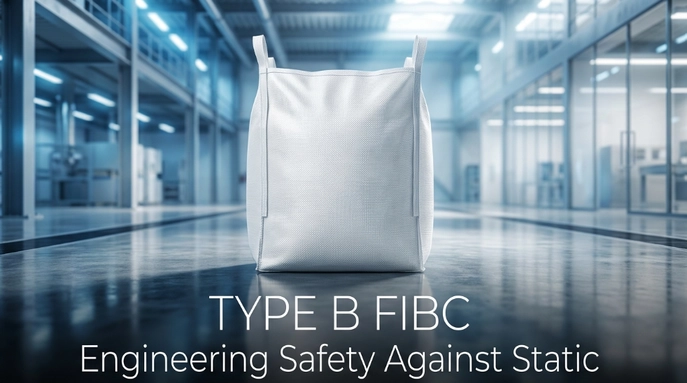
Type B FIBC bags are woven polypropylene bulk bags built with a low breakdown voltage fabric that stops dangerous propagating brush discharges. They reduce one type of static spark risk, but they do not dissipate static charge.
This guide explains what the breakdown voltage limit means in practice. You will also learn how Type B compares to Type A, and what to check before buying.
Type B bags are made from non-conductive woven polypropylene. The fabric is engineered to limit how much voltage builds before it breaks down.
During filling and discharge, powders rub against the bag wall. This friction generates static charge on the surface.
The fabric controls that charge by keeping breakdown voltage low. This prevents the most energetic spark type from forming.
Industry guidance defines Type B fabric as having a breakdown voltage below 6 kV. Many specifications tighten this to ≤ 4 kV for added margin.
A lower breakdown voltage means the fabric cannot hold enough charge to create a propagating brush discharge. That is the high-energy spark capable of igniting fine dust clouds.
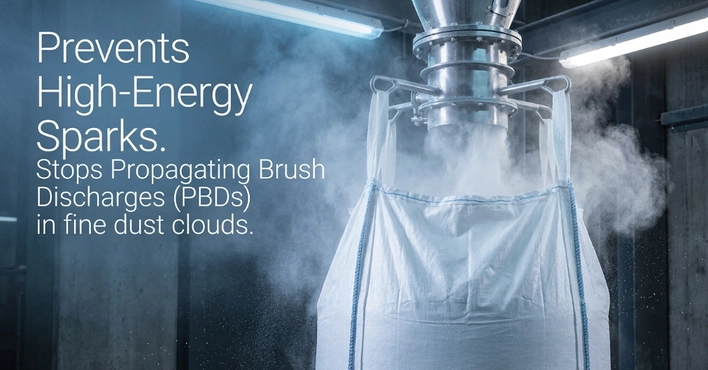
The ≤ 4 kV target is not arbitrary. It defines the line between two very different discharge behaviors.
Low breakdown voltage prevents propagating brush discharges (PBDs). PBDs carry high energy and can ignite combustible dust in the right concentration.
Type B bags do not dissipate static charge. Normal brush discharges can still occur, and these may ignite flammable solvent vapors.
For that reason, Type B fabric is not classified as fully anti-static. It controls one hazard, not all of them.
Type A bags offer no static protection at all. They suit non-hazardous materials in non-hazardous areas.
Type B adds a measurable safety step through fabric engineering. The table below shows where each type sits.
| Property | Type A | Type B | Type C | Type D |
| Static protection | None | Limited | Conductive | Dissipative |
| Breakdown voltage | High | < 6 kV (≤ 4 kV common) | Controlled | Controlled |
| Grounding required | No | No | Yes | No |
| Combustible dust | No | Yes (no gases) | Yes | Yes |
| Flammable gases/vapors | No | No | Yes | Yes |
Type C needs grounding, while Type D dissipates charge without it. Choose based on your actual ignition risk.
For a deeper background, see our guides on the types of FIBC bulk bags (A, B, C & D), everything you need to know about FIBC bags, and the different bulk bag discharge types.
Selecting Fibc type B fabric is only the start. The full operating environment decides whether the bag is safe.
Confirm the powder’s minimum ignition energy first. Then verify that no flammable gases or solvent vapors are present.
Type B suits combustible dust handling in clean air. It is not suited to Zone 0 or Zone 1 atmospheres.
Match liners, coatings, and spouts to your filling and discharge method. A PE liner can protect moisture-sensitive powders.
Always request test documentation. Reliable suppliers provide breakdown voltage results and batch traceability for each order.
Anti-static behavior is verified against recognized standards. IEC 61340-4-4 covers electrostatic test methods for FIBCs.
Ask for breakdown voltage data confirming the ≤ 4 kV target. Charge decay and surface resistance reports add further confidence.
Documentation should link each result to a production batch. QR-based traceability makes that link auditable.
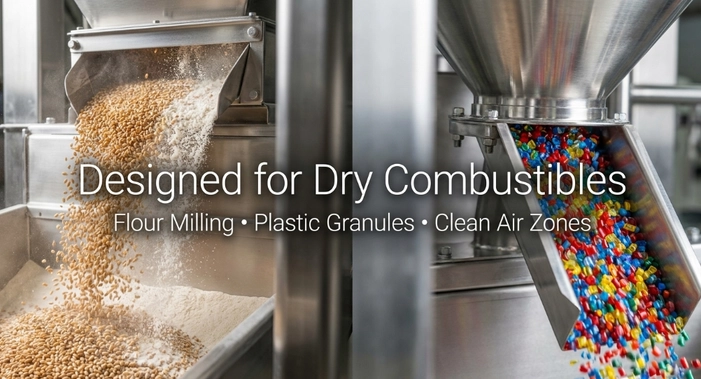
Two short examples show how fibc base fabric type B fits real operations.
A flour mill fills bags from overhead silos. The fine dust carries ignition risk, but no gases are present.
Type B fabric controls PBD risk during filling. Paired with sift-proof seams, it keeps the dust contained.
Plastic granules generate static through friction during transfer. With no solvent vapors nearby, fibc type B provides suitable protection.
A coated fabric here adds weave stability and moisture control. This keeps the granules clean through long-distance shipping.
XIFA Group is a packaging manufacturer producing PP fabric, BOPP bags, FIBC big bags, and PE film bags. With around 25 years of experience and a 72,000 m² facility, the team supports demanding industrial buyers.
In-house manufacturing and 800+ skilled staff keep quality consistent. QR traceability links every batch to its test data, which matters for any type b fibc wholesaler serving regulated markets.
XIFA serves food, chemical, agriculture, construction, and animal feed sectors. Explore our food grade FIBC solutions or our FIBC for lithium carbonate packaging to match your application.
Type B fabric has a breakdown voltage below 6 kV. Many specifications require ≤ 4 kV to prevent propagating brush discharges during filling and discharge.
Not fully. Type B fabric prevents high-energy propagating brush discharges, but it does not dissipate static charge. Normal brush discharges can still occur.
No. Type B bags must not be used where flammable gases or solvent vapors exist. Use Type C or Type D in those environments.
Type B suits dry combustible powders such as flour and plastic granules. The surrounding air must be free of flammable gases and vapors.
Suppliers test fabric against standards like IEC 61340-4-4. Request breakdown voltage results and batch traceability before ordering.