



 by Simin Xiang
If you’ve ever compared packaging samples side by side, you’ve likely noticed that some designs look simple and flat, while others feel more vibrant and detailed. That difference often comes down to how many colors are used during printing.
Understanding this isn’t just for designers—it’s practical for anyone choosing packaging. Whether you want something clean and functional or visually striking, knowing the difference between 2 color printing, 4 color printing, and 8 color printing helps you make better decisions.
Printing works by layering inks to create an image. The more colors involved, the more depth and variation you can achieve. But more isn’t always better—it depends on what your packaging needs to do.
Some products benefit from simple, easy-to-read designs. Others need bold visuals to stand out on shelves. The number of colors directly affects how your packaging communicates your brand.
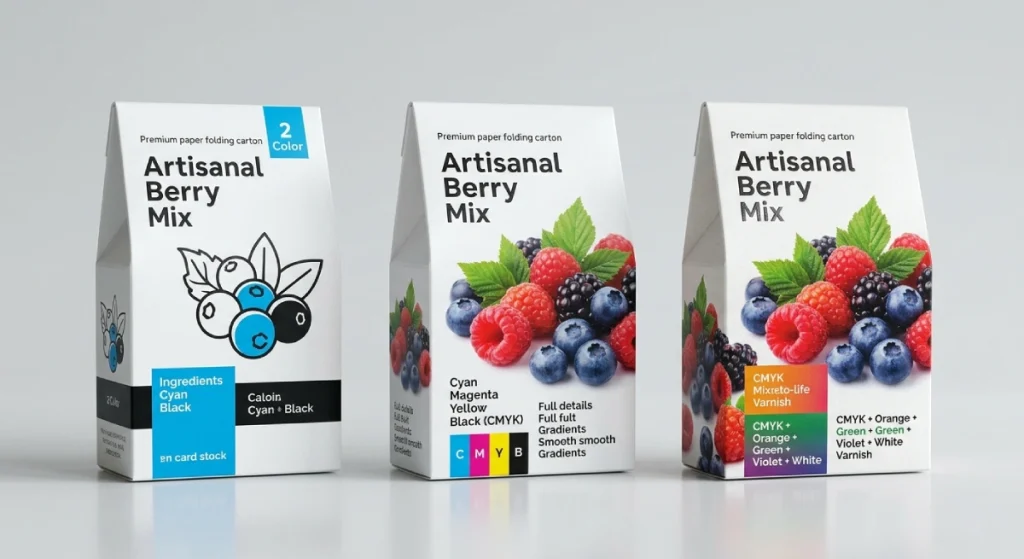
2 color printing uses only two ink colors. Because of this, designs tend to be straightforward and highly readable.
This approach works well for logos, text, and basic graphics. It’s often used in industrial or bulk packaging where clarity matters more than visual complexity. It’s also more cost-efficient and quicker to produce, making it a practical option for large-volume needs.
4 color printing introduces the standard CMYK process—cyan, magenta, yellow, and black. By combining these four inks, printers can create a wide range of colors and tones.
This allows for more detailed designs, including gradients and shading. Packaging starts to feel more dynamic and visually appealing. For many businesses, this is the middle ground—offering flexibility without significantly increasing cost or production time.
8 color printing builds on CMYK by adding extra ink channels. These additional colors improve accuracy, especially for brand-specific shades, and allow smoother transitions between tones.
This level of detail is useful for premium packaging or designs with complex artwork. Colors appear richer, and fine details are more defined. However, it usually requires more setup and higher production costs, so it’s best suited for situations where presentation plays a key role.
There’s no single right option—it depends on your priorities. If your focus is efficiency and readability, fewer colors may be enough. If you want a stronger visual impact, adding more colors can help your packaging stand out.
It also helps to consider where your product will be displayed. Retail environments often benefit from richer designs, while industrial settings may not require as much detail.
As you move closer to production, working with an experienced manufacturer can help you balance cost, quality, and design accuracy. Companies like XIFA Group, with established printing capabilities, can guide you toward the most suitable option based on your needs.
In the end, the goal isn’t to use more colors—it’s to use the right ones to communicate clearly and effectively.
The difference lies in how many inks are used. More colors allow for greater detail, smoother gradients, and more accurate color reproduction.
Yes. It offers a good balance of quality and cost, making it suitable for many retail and branded packaging needs.
It’s best for premium packaging or designs that require precise color matching and great visual detail.